Introducing the Pedagogy of Productive Struggle
Productive struggle needs the right conditions. AI has made them harder to find.
Colleen Ferguson · Executive Director · 17 October 2026
There is widespread acknowledgement that the greatest threat AI poses to learning is the frictionless ease with which students can get answers. They can present those answers as if learning has happened but because they didn’t muddle along the crooked road of missteps, recalibration and grind, the answers don’t contain anything earned. Later, when students reach for the thinking behind those answers, they find it isn’t there.
A colleague of mine was recently at a curriculum development meeting at an international education organisation where a group of educators were designing a math project to be taught in schools around the world. Everyone agreed that productive struggle was essential but they had trouble figuring out how to build it into the assignment so that no matter where it was taught, or to whom, or whether students had access to AI, the struggle couldn’t be skipped.
When my colleague told me this story, it struck me that they were trying to lay a fire someone else would light.
I spent a lot of summers at camp, and of all the things I learned there the one that has stayed with me most is how to build a fire well. A fire needs three things: heat, fuel and oxygen. Take any one away and the fire won’t take hold. Well-placed kindling won’t burn without a match, and flames smother when the logs are packed too tight. But when the wood is dry, placed so air can circulate, and there’s a spark to start it, the fire catches and thrives. A well-laid fire will catch for whoever strikes the match.
In the age of AI, it turns out learning also requires three things in order to take hold.
Almost a year ago, in The Power of Slant, I shared that some colleagues and I were building a teaching framework to preserve productive struggle even when students have unsupervised access to AI. Since then, we’ve done a lot of research, tested our ideas at international conferences and applied the framework in an action research project. This post is the result of that effort. It’s taken a while. The struggle, you might say, was productive.
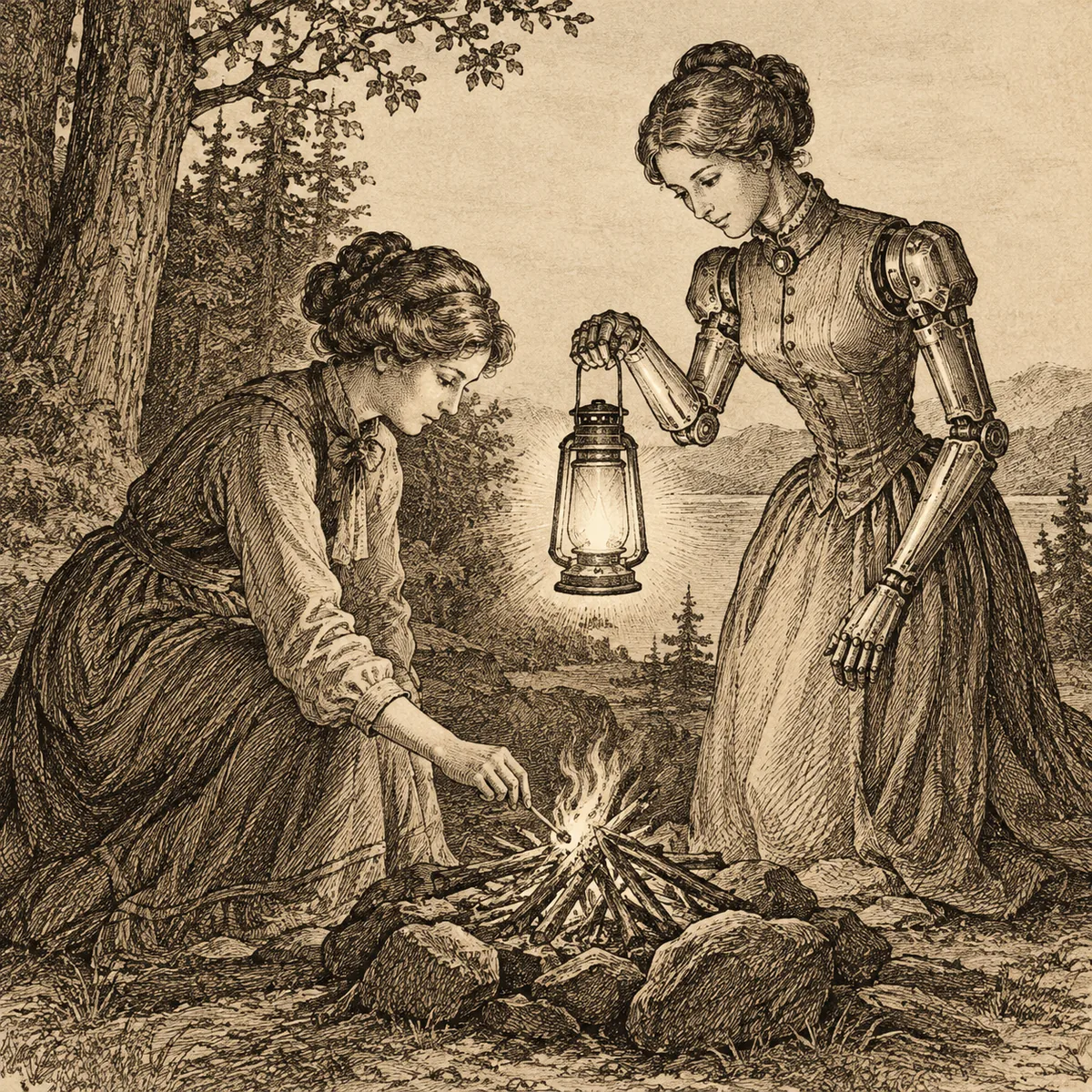
ChatGPT prompt: "In the style of a Victorian line drawing, a woman kneels to light a campfire while an automaton beside her holds out a glowing lantern."
AI Can Light the Way, But It Can’t Light the Fire
There are many reasons students reach for AI to do their coursework, but too often we teachers assume it’s because they’re lazy or avoiding learning. The truth is more nuanced. Students make cost-benefit calculations, and the shortcut usually looks like a small risk worth taking. Either they believe it won’t undermine their learning, or they see it as a necessary evil to get to the place where real learning can happen.
To show what I mean, I’ve created three students. They aren’t real, but they’re composites of students I’ve taught, and if you’re a teacher, I suspect you’ll recognise some of your own students in them.
Latisha puts real energy into her coursework, and she cares, above all, about her grades. She enjoyed finding a focus for her independent study project, chose a topic she was genuinely interested in, and was diligent in her research and writing. But the mandatory reflection at the end? That felt like busywork. So she had AI write it.
Tiger, whose first language isn’t English, was assigned an essay on Hamlet. He wants to do well; he works hard in class and asks questions. He read an online summary so he knows what happens in the play. However, he’s baffled by Shakespeare’s writing and the essay question asks how Hamlet’s language reveals his state of mind. So Tiger had AI produce a draft of the essay, but he plans to write the final one himself.
Alexi is a strong math student who genuinely enjoys algebra. He was given a set of practice problems for homework due the next day. The questions can be solved by AI in seconds and since Alexi had a game after school he got AI to generate the solutions and copied them into his notebook. He figured he’d catch up in class when the answers were discussed.
I hope you noticed that they’re all good students. They aren’t lazy, and they want to learn. But Latisha couldn’t see the point of the task, Tiger didn’t have the foundation to do it, and nothing in Alexi’s assignment ensured that he did the thinking himself.
When I’ve interviewed students who had used AI in just these ways, most didn’t see what they’d done as a problem, and hardly any of them framed it as a tension undermining learning. On several occasions students told me that they had used AI to produce the parts of an assignment that “weren’t important” such as the introduction or conclusion. Many talked about stress and deadlines and saw shortcuts as a necessary way to meet expectations.
They made judgments about which work was essential and which could be outsourced. This might be fine if students and teachers agreed on what’s essential. In my experience, they rarely do. So how do we curb unauthorized AI use when the forces driving it, like stress, deadlines and judgment calls about what’s important and what isn’t, are often outside our control?
I don’t believe an AI ban would do it. As I wrote in Ban the Bans, teen use of AI for schoolwork roughly doubled in the two years after the first wave of school bans. More importantly, a ban can’t touch the underlying problems. It wouldn’t have given Latisha a reason to care, Tiger a way in, or Alexi a better task.
Want To? Able To? Get To?
Outsourcing thinking to AI is a symptom of a bigger issue. Think back to the campfire: when a fire won’t catch, you check what’s missing. Latisha, Tiger and Alexi are fires that didn’t catch, each for a different reason.
This idea is at the heart of the Pedagogy of Productive Struggle (PoPS), which Lincoln Smith, Damion Walker and I developed together. Just as a fire needs heat, fuel and oxygen, productive struggle also needs three conditions.
Motivation: Does the student want to struggle? Do they believe the struggle is worth it?
Capacity: Are they able to struggle? Do they have the knowledge, skills and learning literacy to stay with difficulty?
Opportunity: Do they get to struggle? Is the task designed so the struggle can’t be skipped?
We picture these as three overlapping circles, with productive struggle in the space where all three meet.
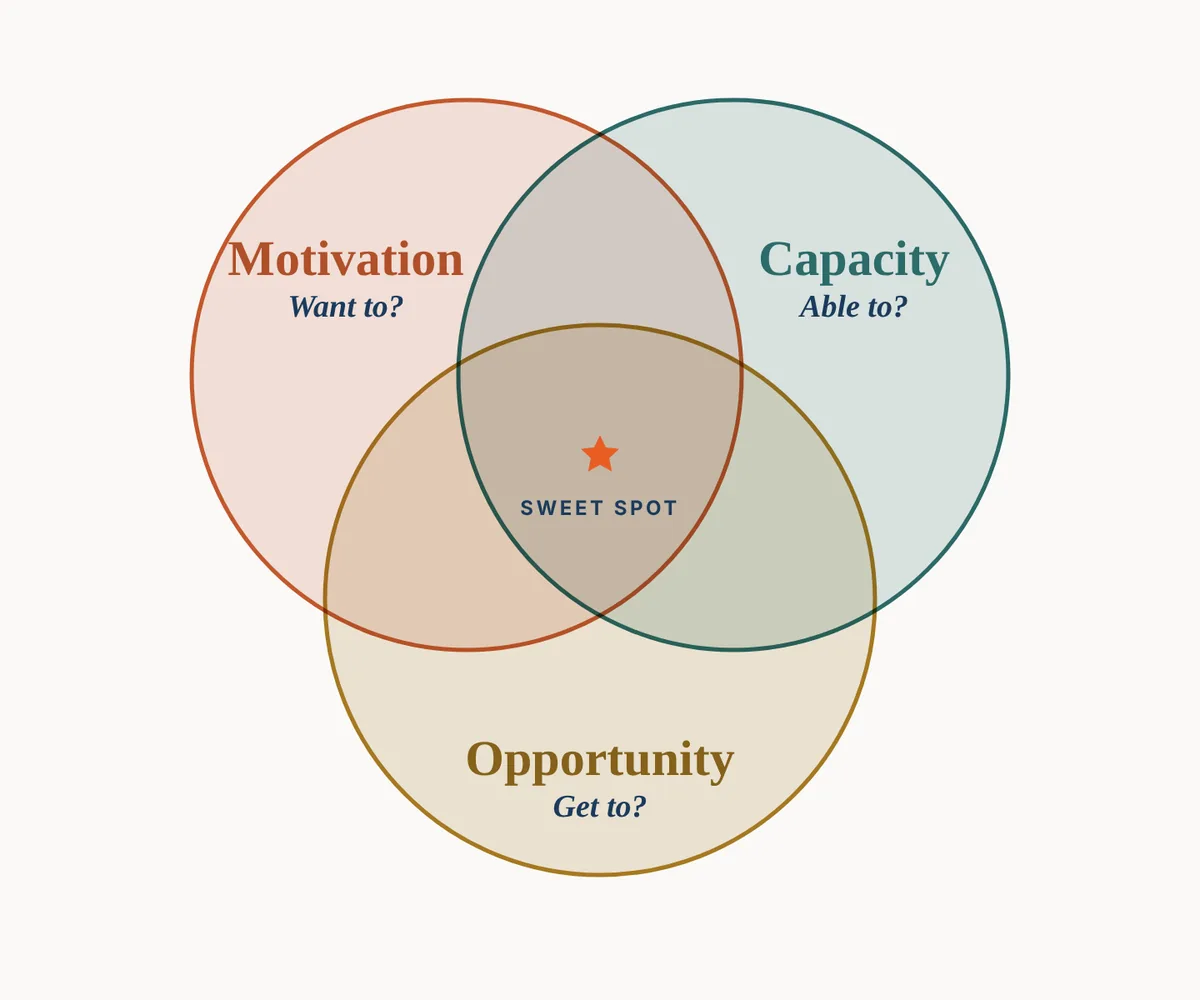
Each of the three dimensions has four elements, and each element can be built with specific classroom practices. But PoPS works best when it isn’t treated as a checklist. We think of it as more of a philosophy, a way of looking at any task and asking three questions. Do students want to struggle? Are they able to? Do they get to? When the answer to all three is yes, productive struggle stops being optional, and AI matters much less. Take one away and, like a fire missing an essential component, the struggle sputters out.
Let’s go back to our three students and consider what might be missing and how it connects to AI use.
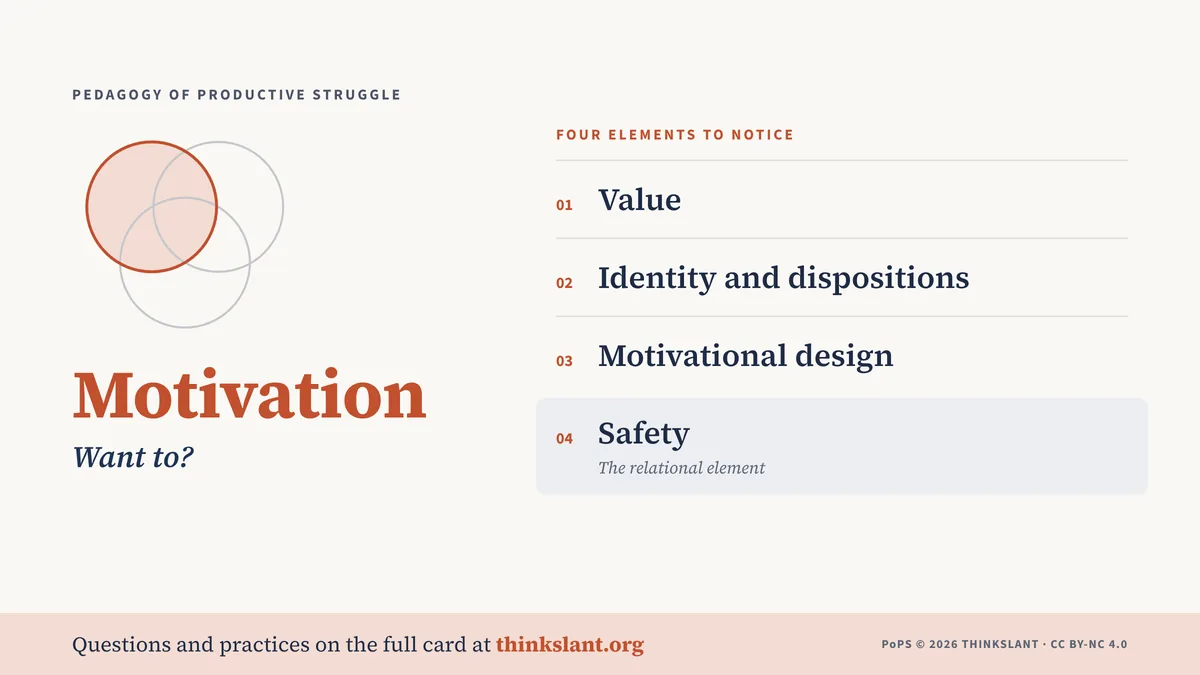
Latisha: No Spark
Latisha had the skills and she had the opportunity. What she lacked was motivation. The reflection felt like a box to tick, and her sense of herself as someone who earns top grades meant that she believed the box mattered more than the thinking inside it.
Motivation has four elements, and Latisha’s story touches every one. The first is value: she couldn’t see how the reflection connected to her own growth. The second is identity and dispositions: the image of herself she was prioritising was the high achiever, not the learner, and that pulled her toward the shortcut. The third is motivational design: how the task helps a student follow through when motivation dips. A reflection tacked onto the end gave her none. The fourth, safety, is the belief that mistakes, even failure, won’t be catastrophic and might actually lead somewhere. An honest reflection means admitting what didn’t work, and that is a risk for a student whose identity rests on getting it right.
Reflection has a bad reputation among students because it usually gets bolted onto the end of a task, when the work is already over. Latisha’s situation is what that design produces. A change that might have reached her is simple: ask students what they want from a task before they start it. If Latisha had been asked at the outset what she most hoped to find out about her topic or herself in researching it, the reflection would have had a purpose. It would have become the place to answer her own question.
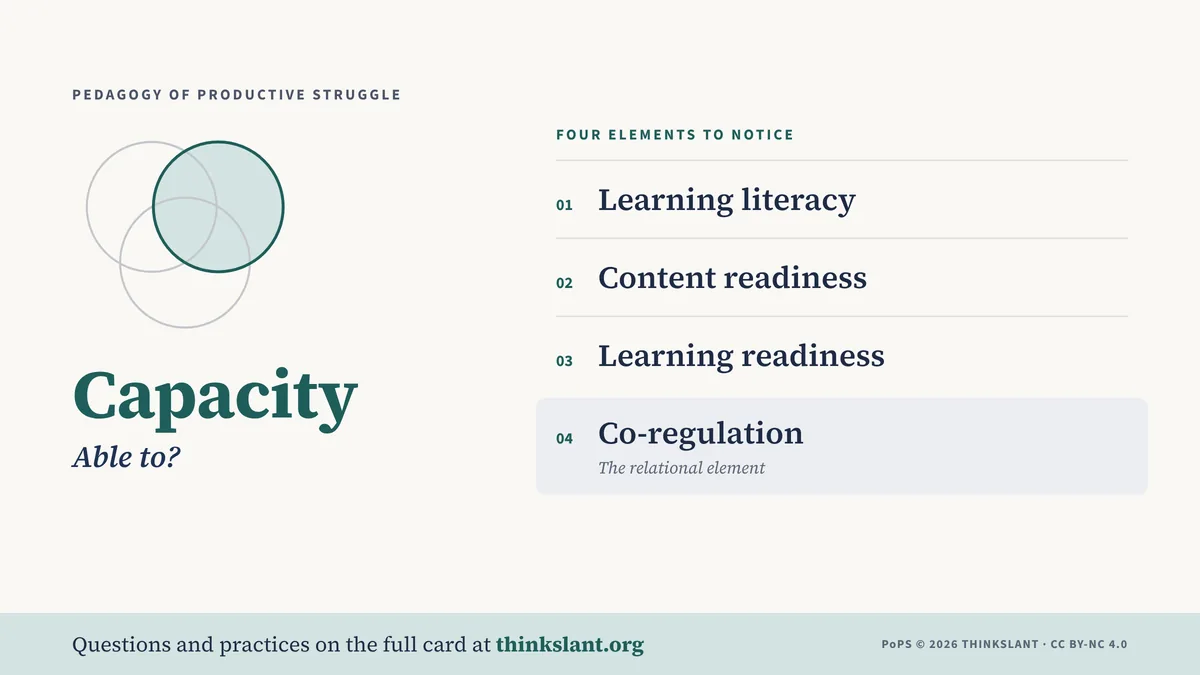
Tiger: All Spark, No Kindling
Tiger is Latisha’s mirror image. His motivation is high, and he did everything he was asked. What he lacked was a way in. The language of the play was out of reach, and without it, he couldn’t see what the essay question was asking him to do.
In Capacity, that’s a gap in content readiness: he didn’t yet have the subject knowledge to do the task, even with support. But it’s also a gap in learning literacy. Tiger couldn’t say what the essay was meant to teach him, so he couldn’t tell which part of it he needed to do himself. His learning readiness was solid; he knew how to use a template and a summary. What he didn’t have was co-regulation: someone to tell him that the confusion, frustration and probably fear he felt were not signs he was failing. They are what learning sometimes feels like.
That’s the moment AI is most tempting. Many teachers know James Nottingham’s Learning Pit, the uncomfortable dip between not knowing and knowing, where real learning happens. My colleague Lincoln Smith has added a feature to that landscape: the AI Bridge of Illusion. AI appears to offer a way across the pit without ever going into it.
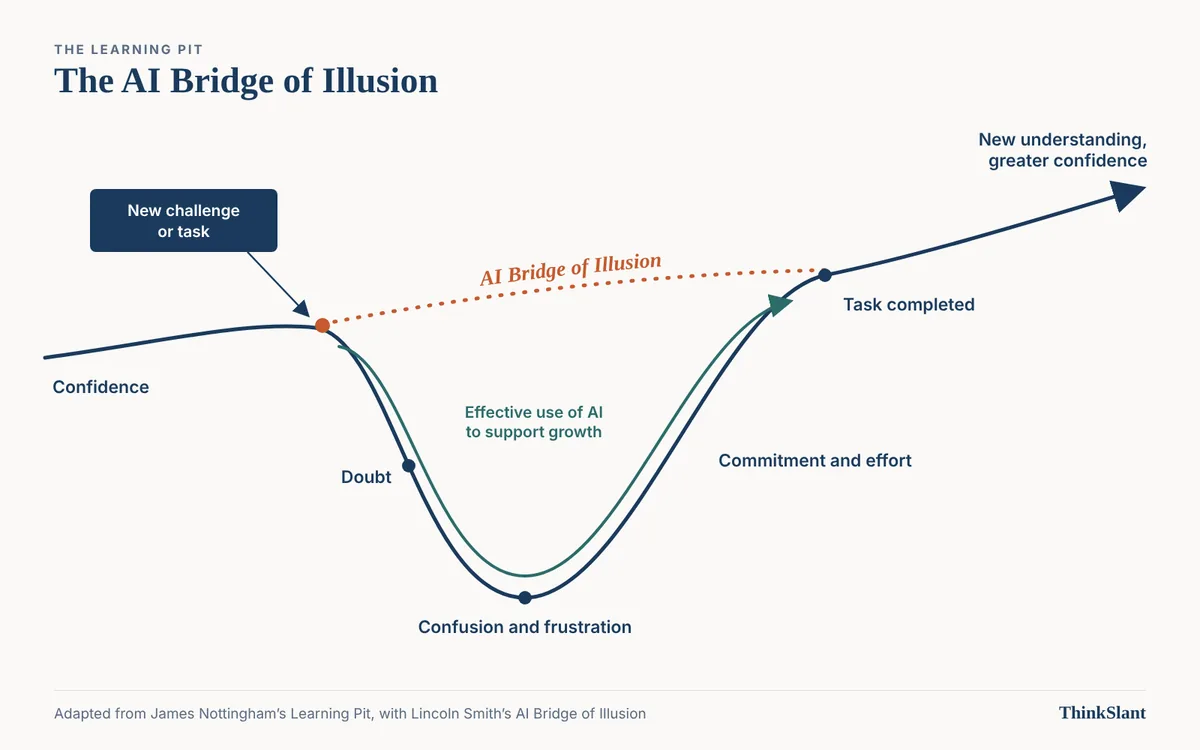
The AI draft feels like learning to Tiger. After all, he plans to write the final version himself. But the thing that confused him in the first place, how Hamlet’s language reveals his mind, is the one thing he hasn’t learned. AI let him believe he’d crossed the pit when he’d never actually gone into it.
What might have reached him is a clearer line between the struggle he needs and the struggle he doesn’t, and a teacher who tells him, before he starts, that feeling lost is part of the process. The essay exists to teach close analysis of language, so that’s the part Tiger has to do himself. Getting there could have been supported. One soliloquy instead of the whole play. A glossed text, or even AI used openly to translate Shakespeare’s English into modern English, so that his effort went into analysis rather than decoding.
Alexi: Learning Snuffed Out
Alexi could do the math, and he enjoys it. But his homework was a set of problems AI could solve in seconds, and it was due on a night when he had a game. The teacher assumed that he would do the thinking but nothing in the task design made sure of it.
Opportunity is the dimension most fully in our hands. Students can always choose to struggle; what we control is whether the task protects that struggle when they don’t. I’ve argued before that AI cheating is a design problem, not an ethics one, and Opportunity is where that argument gets practical.
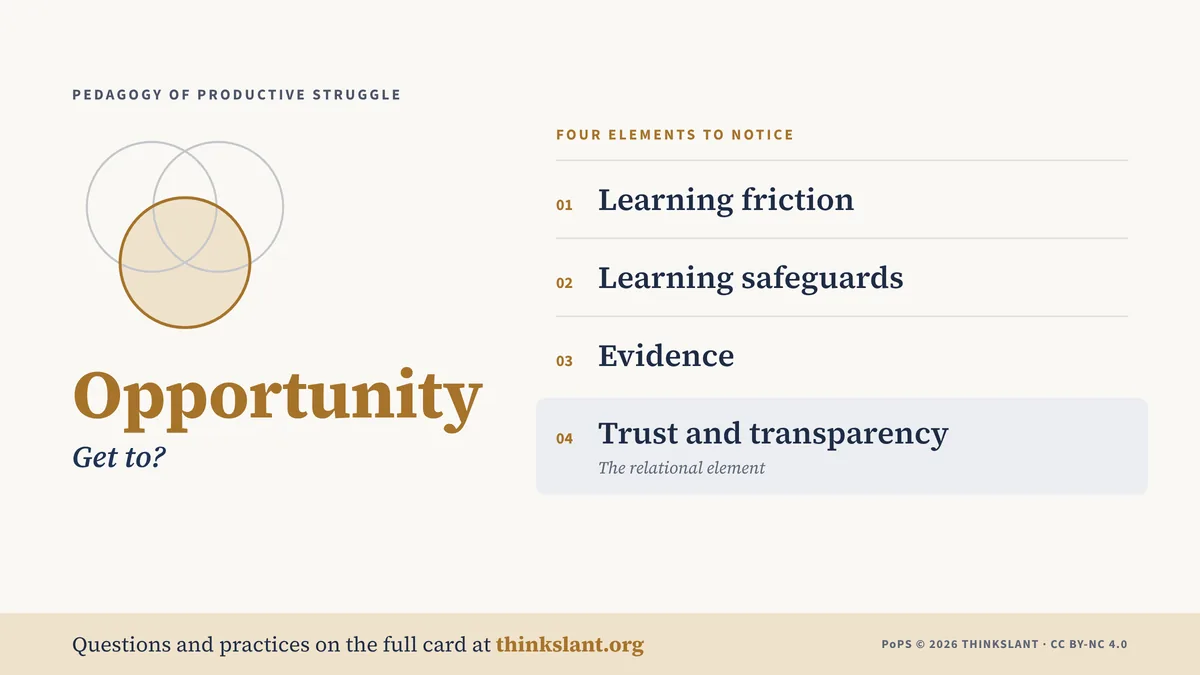
Alexi’s homework task fails on at least two of the four elements in this dimension. Its learning friction was real: practising an algebraic approach is how it sticks. But it had no learning safeguards: AI could produce every answer, and the struggle vanished with them. It asked for no evidence beyond the final answers, so a page of copied solutions looked exactly like a page of earned ones. And the fourth element, trust and transparency, raises another question: would Alexi have felt safe telling his teacher, “I had a game, I ran out of time”? In a classroom where honesty is welcome, the shortcut becomes less necessary.
Before assigning homework, Alexi’s teacher needed to ask, “Could AI snatch away the learning this task is designed to create?” The fix might be as small as changing the homework so Alexi has to defend an approach he developed in class. He could do that with or without AI, because either way he’d be consolidating the understanding he developed in struggling through the problem.
Tending the Fire
Lighting a fire is one thing. Keeping it going is another. As we built out our framework two ideas kept surfacing in every dimension.
The first is relationships. One element in each of the three dimensions is relational: safety in Motivation, co-regulation in Capacity, trust and transparency in Opportunity. They look different in each dimension, but they depend on the same foundation. A student will only tell you honestly whether they’re motivated if they trust you. They’ll ask a person for help instead of a chatbot only if asking feels safe. They’ll be honest about their AI use only in a classroom without a gotcha culture. Self-determination theory has long held that feeling connected to others is a basic condition of motivation. In an AI world, human relationships may be the one thing a machine can’t replace.
The second is reflection. Reflection is how students come to own their learning rather than just complete it. Students can reflect on how they tend to work and plan around it. They pause at the start, middle and end of a task to ask: What is this teaching me? What part do I need to do myself? And teachers must treat reflection as evidence of learning, alongside the final product. Reflection isn’t the thing we tack on at the end. It runs through the whole task.
Applying PoPS
I said earlier that PoPS is a philosophy, not a checklist. In practice, that means starting at the same place every time you design an activity for your class: what key learning does this task exist for? Which part of the thinking does the student have to do themselves for the learning to happen?
Once that’s named, design the task around it and cut what doesn’t serve it. To get there, consider how the task addresses motivation, capacity and opportunity. Want to: how will students get a stake in this struggle before they begin? Able to: what do they need so their effort goes into the struggle that matters, and not into the parts that don’t? Get to: how is that struggle protected, and how will we see it happening? Relationships and reflection run underneath all three dimensions of PoPS.
Here’s what this looks like across three very different learning tasks.
Grade 5 math: The fair share problem. Five pizzas, twelve students: how much does each person get? The point of this task is reasoning about fractions, not finding the answer. Students want to when the problem is real: the class is actually planning food for an end-of-unit celebration. They’re able to when they have fraction strips, drawings and a sentence frame: “Each person gets ___ because ___.” They get to when the work happens in class on whiteboards, each group has to find two different strategies, and a gallery walk asks them to explain someone else’s. There’s no AI in this task by design, which is the point: PoPS isn’t only about AI.
Grade 8 history: A voice from the past. The old version of this task, a diary entry from someone living through an event, is one AI can write in seconds. To change it, start with the key learning: how do historians use evidence to imagine someone else’s perspective, and defend their reading of it? Students want to when they choose a person they feel connected to from the people the sources describe. They’re able to when the class reads the sources together and practises asking what’s said, what’s implied and what’s missing. They get to when they write the diary entry themselves in class, then give it to AI and ask for an alternative entry from the same person on the same day, imagined very differently. Now the student has a rival. Their final task is to decide which version the evidence better supports, and to show their reasons line by line from the sources.
Grade 11 French: Letter to a partner class. Students write a letter in French describing their lives to students at a partner school in Québec. Any translation app could write it for them, so the struggle that matters is producing the language themselves: reaching for a word, building a sentence, getting it wrong and fixing it. Students want to when the audience is real. Someone their age will read it and write back. They’re able to when the class builds a word bank together and practises the sentence patterns they’ll need. They get to when the first draft is written by hand in class, translator closed. Then AI comes in openly, as a tutor rather than a translator: students ask it to point out their errors without correcting them, and fix each one themselves. The evidence is both drafts, plus a short list of the mistakes they caught. The relational part is a teacher who talks honestly about translator use instead of pretending it doesn’t happen.
In one task AI is absent, in one it’s a sparring partner, and in one it’s a tutor. All three start by naming the struggle, then ask whether students want it, can do it and get to do it.
Why PoPS, Why Now?
Very little in PoPS is new, and that’s deliberate. Its practices draw on decades of work by researchers and teachers on motivation, scaffolding, feedback and the value of being stuck. Good teaching is good teaching. What’s changed is the stakes. For most of the history of school, struggle came built in: if you wanted the answer, you had to do the work. AI has broken that link. So the question for teachers is no longer only which strategies work, but which ones protect the struggle that learning depends on. PoPS is our attempt to choose those and arrange them with a purpose.
If you want to go further, PoPS now has a home at ThinkSlant, a non-profit focused on supporting learning for humans in an AI-filled world. We’re about learning, and AI has put learning in jeopardy. There you’ll find resources for bringing the framework into your own classroom, all free to use, adapt and share. No account needed.
Plutarch wrote that the mind is not a vessel to be filled but wood to be kindled. We can’t make students struggle. What we can do is lay the fire well: give students a reason to want the struggle, the means to sustain it and the room to let it breathe. The match, in the end, belongs to them.
Our job is to make sure that when they strike it, it catches.
A note about AI use in this post. Typically, when I write slantwise I use AI only to plan and proofread. The writing is mine. For aspects of the scenarios and the grade-level examples, especially those that fall outside of my area of expertise, the ideas are mine, but I leaned on AI more than usual to help write them up. Teachers with appropriate experience then reviewed them. Human > AI > Human.
© 2026 Colleen Ferguson. Republished from Slantwise.